Friday, February 1, 2013

The Lizard Project: Why Scientists and Teachers Should Work Together for Science Outreach


Originally published on scientificamerican.com's Guest Blog


My high school students recently did something that rarely happens in a science classroom…they did science.
Student Salvador Jahen gets to know a new hatchling.
Although, inquiry based instruction has long been a science education buzz phrase, all too often when kids engage in developing experiments, the answers are in fact already known to science and could be discovered through a quick Google search on the topic. This is not exactly real science. The very nature of science is to ask questions with unknown answers and produce high quality evidence to help us better understand our world. My students took a very specific question with an unknown answer and made a small, but real contribution to what is known about life on our planet.
The results of our work, Maternally chosen nest sites positively affect multiple components of offspring fitness in a lizard appeared in the journal Behavioral Ecologyyesterday. This type of science rarely happens at the high school level. It certainly isn’t expected to happen in an urban high school like Thomas Kelly High School on Chicago’s southwest side, where more than 90% of the students are designated as low income and gang violence is a harsh reality in the surrounding neighborhoods.
Male brown anole in the wild
Although it is extremely rare, it is possible for young students to be a part of real research. Two years agoBlackawton Bees was published in Biology Letters. That paper, which examined how bees use spatial relationships with color to find food, listed 25 elementary school students as coauthors along with neuroscientist Beau Lotto, head teacher David Strudwick and classroom teacher Tina Rodwellyn. This highly publicized work involved a rural British elementary school class in an authentic research process. Students developed the experimental question, carried out the experiment and then students analyzed the results and wrote the discussion in their own words.
That work, published as our experiment was ongoing, helped to give me confidence that what I was trying to do with my students was indeed possible. Like the Blackawton Bees experiment, our research can change perceptions of what is possible in a science classroom and produced results that I feel are relevant to the way that researchers approach outreach and the way that we think about science education in general.
Our experiment, quickly dubbed The Lizard Project by my students, asked the question, “How does the choice of an egg laying female’s nest site affect the survival of her offspring?” This question is the same type of question that is frequently asked by professional researchers like my collaborator Dr. Dan Warner, but it is not the type of question that is typically asked by high school science students. To ask this question we moved 80 lizards into our classroom and started doing science.
Attempting to do a large scale experiment required a shift in the way we did biology class.
High school kids were involved in all aspects of the experiment
High school students were involved in all aspects of the experiment
There would be no scripted set of procedures from the text book. Our question would not be answered neatly inside of two or three 45 minute class periods before we moved on to the next topic. My students and I were forced to improvise. Students got to take part in the process of figuring out the best way to answer our question. Rather than collecting data for a prescribed number of class periods, we collected data until we could reasonably answer our question with the level of confidence required of professional researcher. Although we didn’t completely abandon the other topics in biology, we committed to seeing the project through and it took us more than four months to do that.
I made the decision that my students would have the chance to be inspired to learn by diving deep into the process of actually doing science. In practice this meant that strictly teaching to the test would be impossible, but I don’t for one minute worry that my students suffered from doing science rather than learning about science. The look of wonder on a student’s face was unmistakable when they proudly held a tiny lizard egg in a dirt covered hand after diligently sifting through the potting soil in hundreds of our nesting boxes.
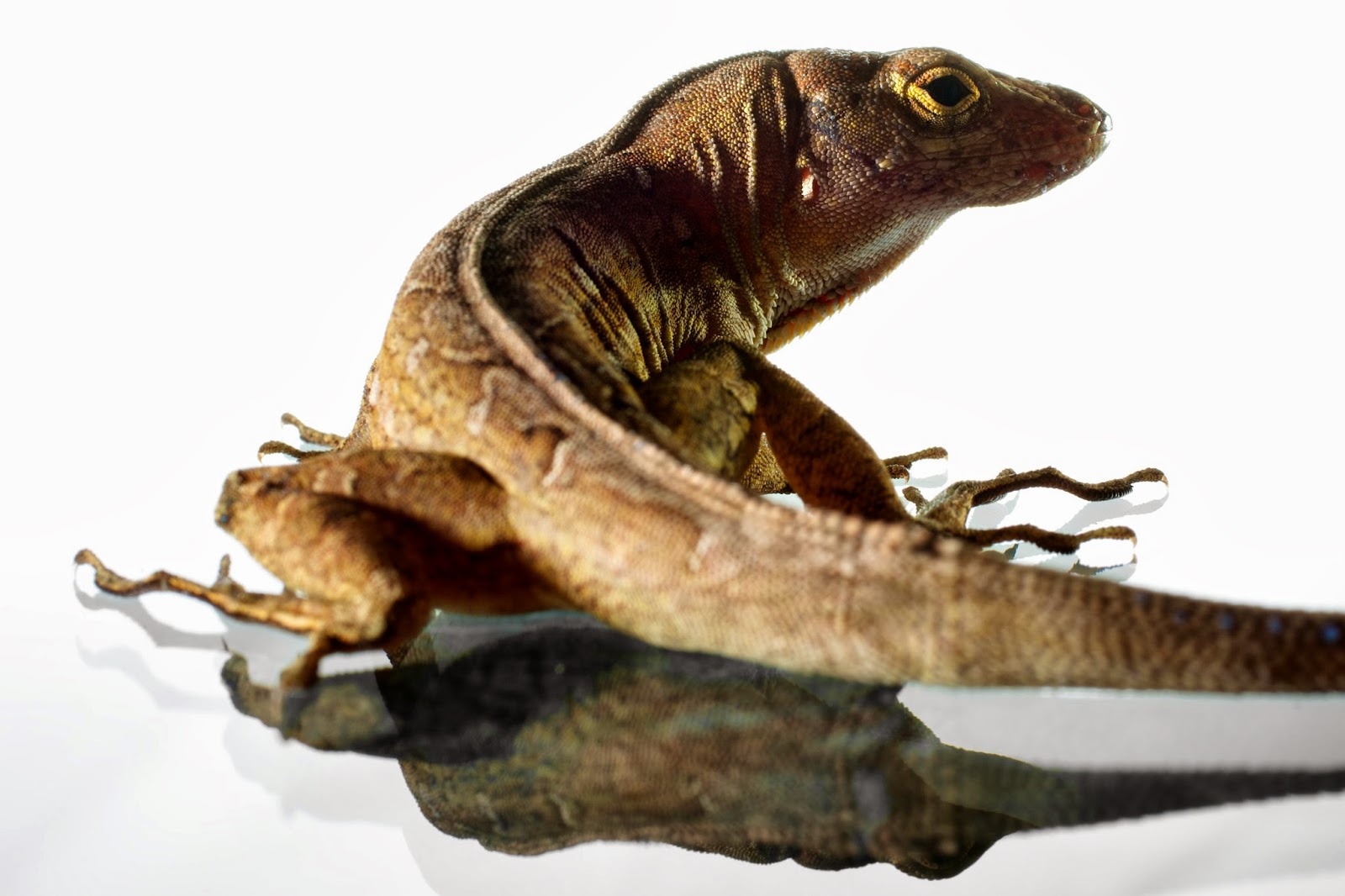
Brown anole
Brown anole. Photo: Vince Musi
That very same sense of wonder is what drove many of us to be scientists and science educators. Even though the personal love of science that I watched grow in so many of my students throughout the project would be justification enough for learning by doing, I was satisfied to see that despite straying from the prescribed curriculum, my biology students have been shown to score at or above the level of their peers in other classrooms at our school.
Although it is far from guaranteed when engaging in authentic research, my students did find an answer to our research question. The data my students collected showed that female brown anoles are highly sensitive to moisture when choosing a nest site and that this choice of nest can have serious survival consequences for her hatchlings through the first 12 weeks of life. We found that a good choice of nest can lead to as much as a 22% increase in offspring size, when compared to a poor choice.
The results of our NSF supported. classroom research were significant. However, more important is the way I think our project has the potential to change perceptions about the high school science classroom and what is possible for collaborations between researchers and teachers. Our experiment was considerably outside the bounds of typical high school curriculum and the logistics of converting my classroom to a functioning live animal lab was no small hurdle. My students managed more than 100 lizards in 30 controlled enclosures for more than 4 months.
Doing this type of science may be outside the realm of possibility for most teachers working i­ndependently. In this case, our experiment was only possible because of a long-term collaboration with Dr. Fred Janzen’s evolutionary ecology lab at Iowa State and particularly with Dan Warner (now an assistant professor at the University of Alabama at Birmingham). This relationship has proven tremendously beneficial to me, my students and Dr. Warner as we all contribute to, and learn from, real science. Completing this project leads me to believe that our work can be a new model for both researchers and classroom teachers. Here are five reasons why I think it is in everyone’s best interest when scientists and science teachers work together.
1) Science outreach works best when it is ongoing.
Far too often the model for outreach is a classroom guest lecture from a visiting scientist. The ongoing collaboration, developed over three years, with Dr. Warner and the Fred Janzen Lab at Iowa State allowed for me and my class to tackle a much deeper exploration of the scientific process than ever before.
2) Teachers are experts in communicating science to kids in a way that researchers are not.
Although many researchers are great science communicators, they do not typically have education training that matches that of a typical teacher. Teachers also have existing relationships with students that are vital to motivating student learning. Students benefit when the collaboration leverages the relative strengths of both teacher and researcher.
3) Researchers are in a great position to work with teachers to foster intellectual growth and develop original experiments.
Our entire system of producing PhD scientists is already based on researchers working with motivated college graduates to encourage scholarly growth through independent research. Because of this system, it is very easy for researchers to work in this type of relationship with an interested and motivated science teacher to the benefit of both.
4) The best science learning experiences in schools are big enough to be shared.
Large scale projects offer enough hands on experience to draw students in before they have the opportunity to sink their intellectual teeth into real data analysis. This project was large scale by high school standards. To start with we had 80 lizards in 20 enclosures. By the end we had a total of 30 enclosures and lizards hatching out of the incubator almost daily. Typical public high school teachers have 100 to 150 students at any given moment. All my students got to be thoroughly involved with the experiment precisely because there was so much animal care, data collection, and analysis to be done. A smaller scale project would not have provided as many opportunities for the direct hands-on work of so many students.
5) Outreach doesn’t have to take away time from research.
When researchers and teachers take the time to establish true professional collaboration, the lines between outreach and research are blurred. Dr. Warner committed to working with our class in a truly collaborative role. Through his commitment we were able to produce data that advanced his research while having a broader impact of the type that funding agencies like to see. When scientists and science teachers truly collaborate, science happens, everyone benefits and kids everywhere are capable of doing real science.
Aaron ReedyAbout the Author: Aaron Reedy previously taught biology at Thomas Kelly High School in Chicago, where he used innovative projects to connect his classroom to the wider world of science. In pursuit of great education, he kayaked down the Mississippi River, immersed kids in studies of wild reptile reproduction and climate change, carried out professional-level science in the classroom and engaged schools in live video chats from the field. Right now, he's a team member on a National Geographic/Waitts grant to investigate the role that the sex ratio plays in evolution and population growth in island populations of lizards. Earlier this year he spoke at TED on teaching kids about how we know what we know about evolution. He is currently a fellow at the Jefferson Scholars Foundation at the University of Virginia working on a PhD in biology. His blog Wide World Sciencebrings field biology into classrooms and shares the work of his students with the world. Follow on Twitter@mr_reedy.
The views expressed are those of the author and are not necessarily those of Scientific American.

Thursday, May 17, 2012

If it's worth doing, it's worth sharing...online.

One of the best ways to make work meaningful and authentic to high school students is to have them share their work with an audience. This is a generation that, for better or for worse, posts their every waking move on line. If its important to them, they post it on Facebook or put the video up on YouTube. I began to notice this when we were working on an exciting lesson in class (dissecting sharks, simulating meteor impacts on the moon, racing cockroaches, etc.). Students would ask me if they could take video of the lesson to show their friends. To the typical high school student if it is exciting, it is worth sharing. For them, sharing often makes an experience feel important. By tapping into this, teachers have an opportunity to increase student engagement, and now that anyone can set up a blog in a matter of minutses, it is easier than ever for teachers and students to share student work with the wider world. When I told my students that they would be sharing their projects (podcasts) online, I was amazed to see just how much more important the assignment became to them.

Their assignment was to research the global extinction crisis currently facing amphibians.  With over 1,900 species of amphibians currently facing the threat of extinction, we run the very real risk of loosing 1/3 of all amphibian species in our lifetimes. These alarming statistics helped to grab their attention, but what really inspired them to make a creation worth sharing was simply the fact that I planned to share it with a wide audience.

Recently I found myself with the TED-Ed recording unit that I used to record the narration for this animated video http://ed.ted.com/lessons/sex-determination-more-complicated-than-you-thought. I included my students in the process when I was making the video and I shared the rough draft of the animation with my students before it was released on ed.ted.com. My students were fascinated with the process of me creating and sharing my own work with the world.  Since I still had the recording equipment that TED had sent me, I decided my students should use it to record their own creations.  This set the stage for them as they began creating their own podcasts. I think they really got a kick out of using the portable sound recording booth (a well designed hood of sound dampening foam).

I asked them to write and record 30-90 second micro-podcasts that would each highlight the plight of one individual amphibian species.  While it might not be a very big step towards world wide amphibian conservation, I hope that it helped my students see that they have the power to create and that it is now easier than ever to share your creations with the world.

Here is what they came up with: http://endangeredamphibians.blogspot.com/ It is a blog telling the world about the endangered amphibians that they learned about.  They have been thrilled to see it shared online. For them, and for many high school students, the important things are worth sharing.


Tuesday, April 24, 2012

What I wish for my TED-Ed video.

In a few hours the folks at TED will be launching a new website, TED-Ed.  The site is meant to build on the popularity of the incredibly viral TED talks on the TED.com website.  TED talks have become so popular largely because, as the tagline says, they share "riveting talks by remarkable people, free to the world". However, I think that they have also become so pervasive because of their share-ability.  One click and they are posted on your Facebook wall or attached in an email to a friend.  This has been an extremely powerful tool for spreading ideas.  Indeed the average TED talk is viewed online more than 100,000 times and the most popular talks have been viewed millions of times. The most popular of which is Ken Robinson's talk, Schools Kill Creativity; it has been viewed more than 10 million times. (If you haven't seen it, watch it now!)

With the launch of TED-Ed, they are hoping to take that extremely powerful brand for sharing ideas, and extend it to the world of teaching.  They want to take the best lessons from teachers around the world and help that teaching go viral. To do that they are concentrating on a format that has the best chance of being easily spread online and into classrooms everywhere. They are keeping the videos short (all less than 10 minutes with most at around 5-6 minutes).  They are also pairing teachers with some of the world's best animators to give the lessons visual snap and and an element of surprise that can be tough to do with a straight lecture format.

After being lucky enough to be invited to give a TED talk last month at TED 2012, I am now also lucky to have one of my lessons up on the TED-Ed site for its official launch.  Therefore as TED's new creation is about to be judged by the world at large, so is mine. To be fair, it is not entirely my own creation. I worked with legendary animator Candy Kugel on the project and her work breathed a playful spark into my teaching that I wish could be there everyday. None the less, I do feel very connected to the work and I definitely feel a sense of shared ownership for the project.  As my lesson is about to take its first few steps out into the internet, I find myself reflecting on my hopes for its online future.


My lesson, Sex Determination: More Complicated Than You Thought, is really a 5 minute summary version of 3 of my favorite 45 minute lessons that I teach on sex determination in animals. Over the last seven school years of teaching high school biology, I have seen that these lessons consistently fascinate my students.  When the folks at TED asked me about creating a lesson, sex determination was immediately on my mind as a possible topic.  When they told me that they wanted it to be about 5 minutes long it forced me to stop looking for a way to recreate my best lessons on the topic and instead create a new type of lesson.  A lesson that would distill the essence of those other lessons, but still remain clear and would leave students wanting to know more.  That is indeed my biggest hope for this project; that it will make students want to learn more.

I know that in five minutes I could never thoroughly teach a topic as complex as sex determination throughout the animal kingdom.  I also know that videos, no matter how captivating, will never replace a passionate teacher.  However, I do believe that you can inspire a student's curiosity in a single moment and that curiosity can propel a student to learn for a long time. So that is my hope for this video and I think it is TED-Ed's hope for their new website.  I hope that it will help teachers to generate that spark of curiosity in their own students and become a great tool that is used to support and inspire great teaching as it was meant to be- curiosity driven person to person.

Tuesday, April 10, 2012

Lizard Project Day 14: That's a wrap...for now. Thanks for following along with us.

All good things must come to an end.  We have finished the field work for this spring season of The Lizard Project.  We have nearly all the adult lizards on our study islands marked.  We found out who survived during this past year and who did not.  In the fall we will return to the islands to capture and mark the baby lizards that will be born this summer.  We will then collect DNA from those babies and find out which individual lizards and which traits were successful in yet another generation of lizards on our islands.  We hope to find answers that will tell us how the environments of the islands are shaping the natural selection and evolution of these populations of lizards.  It is our hope that this will help us to better understand how all life on our planet evolves.  I think that I speak for the entire team when I say that we are already looking forward to the next trip down to the islands.

On our final day in Florida, National Geographic Photographer Vincent J. Musi, photographed our lizards.  He brought a real passion and curiosity to our work and I think it shows in his photos. The Lizard Project team has spent countless hours looking closely at lizards, but I know that we have never seen these animals in quite the same way that we saw them through the lens of Vince's camera.  Even though they are small and often overlooked, these little guys really are beautiful animals and we think that Vince's photos will help people to see that side of them.  This little guy is quite the handsome dude. Don't you think so?
That is one good looking lizard. Photo by Vincent J. Musi


Saturday, April 7, 2012

Lizard Project Day 12: Almost all the lizards are marked and we're getting ready for a special guest.

Today we were very happy to see that almost all the lizards on our islands have stylish numbers on their sides.  This means that we have already captured and marked them and that means that our work here is almost done for this trip.

 
We have been having so much fun doing science down here that is seems hard to believe that we only have a couple of days left before we have to head back home.  We will be returning on home with notebooks full of data to analyze and we can't wait to answer some of our many questions. Does the sex ratio effect survival?  Is natural selection working differently on male and female dominated islands? Are growth rates the same on all of our islands? Does the dewlap size really matter when it comes to survival and reproduction? We will soon have answers these questions and more and we are looking forward to that.  


However, we are not quite done yet here and we want to make the most of our last few days. Tomorrow we have a special guests joining us and we are really looking forward to it.

Tomorrow, National Geographic photographer Vincent Musi and his family will be arriving here at the field station.  I met Vincent at the TEDxMidwest conference last year in Chicago. I happened to sit down next to him and his wife Callie (also a profesional photographer) at lunch. We started talking and I told him that I did science with lizards that was supported by National Geographic. He told me that he makes photos for National Geographic.  I asked him how I could take better lizard pictures.  He got so excited about giving me photo advice that about 15 minutes later we were planning his trip to meet up with the lizard project and take pictures of our lizards.  We are thrilled that he is coming down.  Vince is well known for making animal photos and, although he usually works with slightly larger animals, we can't wait to see the pictures he is going to make with our little lizards. Check out some of Vince's latest work with National Geographic if you want to see why we are so excited to have him shoot our lizards. 

He's a bit bigger than our lizards. Photo by Vincent J. Musi in National Geographic.

Friday, April 6, 2012

Lizard Project Days 10 & 11: Animals

We have now caught, tagged and released 572 lizards on this trip into the field.  We have already shared with you guys how we search for lizards, how we catch lizards, how we measure lizards and how we learn about evolution by studying lizards.  However, this post is not about lizards.  This post is about all of the other amazing animals that we get to see when we are out working on the islands.

 Manatee. Photo courtesy of shutterstock.com.
Manatees: This morning while we were paddling out we heard loud snorting and blowing. A huge tail then appeared appeared out of the water and two, thousand pound manatees rolled onto their sides and looked at us. We think that they were in the act of mating. They looked at us and continued swim slowly nearby, while they rubbed against each other.  They stayed close to us for about a minute until a power boat came close to them and scared them off.
The lizard project team gets a close up view of manatee mating on our morning commute.

Eastern Glass Lizard on Little Island.  How many of our lizards has he eaten?
Eastern Glass Lizard: Early in the trip we found an Island Glass Lizard, a seldom seen species of legless lizard swimming in the estuary. We thought we were lucky to see a legless lizard period, but yesterday we found another species of legless lizard on one of our islands (I wonder how many of our study lizards he has eaten?). This one was the Eastern Glass Lizard.  When we were releasing him, we accidentally caused him to eject his tail. We were sad that this happened, because it will probably take this lizard a while to regrow such a big tail.  They have the ability to eject their tail to escape from a predator.  When the tail is detached it wiggles like crazy to keep the predator distracted while the lizard escapes.  We filmed it and you can watch by clicking on the video.
video

Yellow Rat Snake: We found this critter on the mainland, but we have seen these on our islands before.  Like their name says, they like to eat rats and small mammals.  They also probably like to eat our lizards when they are small.  We have not seen any of these out on our islands this trip, but we have seen evidence that they are there.  We found two large skins that have recently been shed out on island L.  Andrew, the resident snake expert on our team, determined that they were skins from two very large (almost 5 feet long!) yellow rat snakes.  If you are
interested in learning about how Andrew can identify a snake from it's shed skin, read his latest blog post on his blog SnakesAreLong.blogspot.com http://snakesarelong.blogspot.com/2012/04/identifying-snake-sheds.html#comment-form


Great Blue Heron: These big beautiful birds are really common on the estuary.  Almost every morning when we put the kayaks in the water.  These guys are sitting on the dock with the fisherman.  Watch this short video of one wading along the shore of Island M.

video

Still can't get enough Lizard Project.  Check out Tim Mitchell's post on timsfertileturtles.blogspot.com about the strange language of lizard catching.

Tim's Fertile Turtles: Lizard Project- Day 10. Lizard Lingo!: We are on the cutting edge of evolutionary biology, but also on the cutting edge of developing new vocabulary.  After spending days and days trying to catch lizards, we have developed some new vocab words. 

Wednesday, April 4, 2012

Lizard Project Days 8 and 9: A field day in the life of an evolutionary biologist.


As a biology teacher it seems to me that many kids who would make really great biologists (Maybe you are one of those kids!), don’t become biologist because they don’t  know any biologists personally and can’t picture exactly what it is they would do as a biologist.  Here at WideWorldScience we love what we do and we want to share it with you.  While it is true that there is a lot of time spent back at the lab, analyzing data, teaching classes, planning experiments and preparing for field expeditions, all of us love to get out and do science in the wild.  We really do love working with our friends outside, paddling kayaks, looking for wildlife, climbing trees and chasing lizards. We live for these field trips!  Here is a typical field day in the life of a biologist:

Dan and Andrew with our rental truck and kayak trailer.
6:30 Wake up- Four of us are packed into the tiny bunkhouse room at the Guano Tolomato Matanzas Estuarine Research Reserve.  It is small, but it has air conditioning, running water, electricity and an internet connection, so we are glad to have it.  Many times we camp in tents while we are working in the field.

6:45 Breakfast- cereal, milk and bananas


.7:15 Packing the gear- We pack up all of our gear into the truck for the day.  This includes, lizard nooses, lizard bags, drinking water, dry shoes, sunscreen, cameras, animal coolers, lizard noose repair kit, duct tape (you always need duct tape), life jackets, kayaks, paddles and of course lunch (usually pb&j sandwiches, apples and granola bars).

8:00 Drive 3 miles to the boat launch- This is where we put the kayaks in the water.  There are lots of fisherman that put their boats in the estuary here.  It is a busy place.
The commute to the office.

8:30 Paddle out to the islands- This is one of my favorite parts of the day.  It takes about 10 minutes to paddle to Island M, our closest island, and about 45 minutes to paddle to Island F, the furthest island.  We often have dolphins swim near us while we paddle.

9:00 We land on an island.  This requires us to wade through the shallow water.  Since Tim cut his foot on an oyster shell two days ago, we have to help him keep his feet dry. See this video.
http://bit.ly/Hp77FL


This lizard has already been captured by us.


9:15- 12:15 We hunt for lizards on the island.  We just walk around carefully looking for lizards in the trees.  When we find one we then try to noose it.  We put numbers on those that we have already caught so we don’t catch them again accidentally.


12:15- 12:45 We take a break to eat our lunch.

1:00- 4:00 We move to a second island and catch lizards there.
Looking for lizards in all the wrong places.

4:15 We paddle the kayaks back to the boat launch and load them back up on the trailer to drive back to the field station.

5:00 Cold Showers-  Sometimes we even stop for ice cream on the way home.

5:00 to 6:30 Blogging, Tweeting, Cooking Dinner and updates data notebooks


Processing lizards.
Science is fun, but it is hard work. Rest up there are still more lizards out there!
6:30-10:00 Processing Lizards.  This is what we call it when we measure, weigh, mark and take tissue samples from the lizards.

10:30 Sleep time!  We are really tired by this point in the day!